Lou Nasti runs a factory in Brooklyn that makes animatronic Christmas displays. He's been at it for almost 44 years.
Neda Ulaby/NPR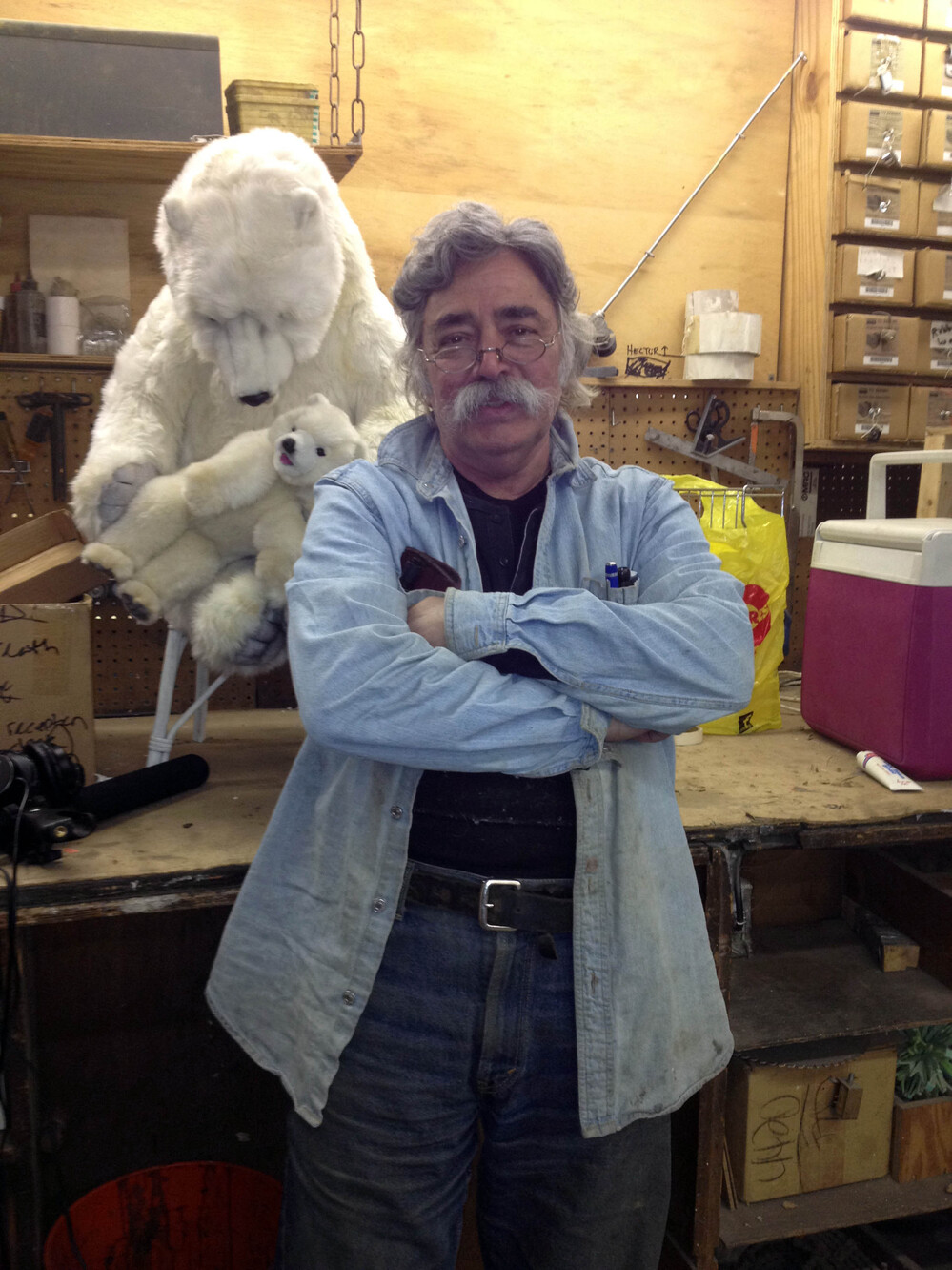 Lou Nasti runs a factory in Brooklyn that makes animatronic Christmas displays. He's been at it for almost 44 years.Neda Ulaby/NPR
"Everyone calls me Geppetto," announces Lou Nasti. "I mean, look at me: The glasses, the gray hair — and I play with dolls. Come on."
Being with Nasti at his Brooklyn company, Mechanical Displays Inc., is like hanging out in Santa's workshop. The walls are lined with tools and dozens of molds for elf heads, all in different sizes. Dancing mice and snowmen are being prepped in a chorus line for HBO's headquarters in Manhattan. For another display, a plush mother polar bear is being wired to cuddle her baby. Life-size toy soldiers stand by a life-size talking tree, a current work in progress.
For almost 44 years, Nasti has created holiday-themed displays for department store windows and shopping malls, the kind featuring animatronic elves wrapping presents, sweet-faced reindeer bowing their heads and Santa snoring, perhaps with a tail-wagging puppy at his feet.
"I have worked for the king of Morocco," says Nasti. "I did the B. Altman's window for 18 years prior to their going out of business. I did Gimbels. I've worked for Macy's Santa Land."
Nasti's displays have been seen in most of New York City's major department store windows. He started as a window dresser as a teenager and landed on the front page of The New York Times when he built a giant robot that could walk and talk. A few years later, he started his company.
Mechanical Displays has sold thousands of holiday displays across the United States. One Christmas, Nasti remembers installing a display at a department store in Ohio and peeking into the window of a Hudson's across the street ... where workmen were putting in another of his displays, one he'd sold years earlier to a store in Minneapolis. Some circulated from store to store. Others stood out for other reasons.
"Many years ago we did an animated Nativity for Macy's," Nasti recalls. "We put it in the window, and we had baby Jesus moving, and Mary and Joseph. Very discreet. Very, very discreet. They got calls! Macy's got calls that it was disrespectful to animate baby Jesus. He wasn't crying or anything; it was very well done!"
Over the past few decades, the market for these figures with their repetitive motions and uncanny fixed stares has changed. Online shopping put a dent in department store budgets and changed their priorities.
"The department stores have cut back," Nasti grumbles, "because they want to fill every square inch with retail."
Nonetheless, Nasti remains busy. He just finished building a children's train ride through a sprawling peppermint forest for the Galt House Hotel in Louisville, Ky. The project, he says, was huge.
"Thirty thousand lights, 150 Christmas trees, 30 rolls of Dacron, 250 pounds of poly loose snow, and 90 animated figures making candy canes and gingerbread and having a party in the forest," he says proudly. "I mean, I got teddy bears warming their feet on fireplaces and squirrels toasting marshmallows. It's adorable."

 Hide caption By the late 1950s, Kubitschek was president of Brazil, and he invited Niemeyer to design many of the civic buildings in the country's new capital of Brasilia, including the Palacio da Alvorada, the official residence of Brazilian presidents, pictured here in 2006.
 Hide caption A church, pictured circa 1955 on the grounds of the presidential palace, is connected to the palace by an underground hallway.
 Hide caption The Oscar Niemeyer Museum, inaugurated in 2002, the largest museum in Latin America, is in Curitiba, the capital of the state of Parana, Brazil. Curitiba, considered an outstanding example of urban planning worldwide and the ecological capital of Brazil, was chosen as one of the 12 host cities for the 2014 soccer World Cup.
 Hide caption Brasilia Cathedral was inaugurated by President Juscelino Kubitschek in 1960.


 Hide caption Brasilia's National Museum, inaugurated in 1960.
 Hide caption Construction for the headquarters of the French Communist Party began in the late 1960s.
 Hide caption "The Volcano" at Le Havre Cultural Center, France, built in 1982.
 Hide caption The Niteroi Museum of Contemporary Art near Rio de Janeiro, built in 1991. Vanderlei Almeida/AFP/Getty Images
 Hide caption Oscar Niemeyer International Cultural Center of Asturias, Spain, built in 2006.
 Hide caption Auditorium Oscar Niemeyer in Ravello, Italy, on the day of its inauguration. Roberto Salomone/AFP/Getty Images
 Hide caption A pianist at Auditorium Oscar Niemeyer in Ravello on the day of its official inauguration in 2009, with Italy's Amalfi coast in the background. Roberto Salomone/AFP/Getty Images
 Hide caption The inauguration of the Oscar Niemeyer foundation building in Niteroi, Brazil, 2010.
 Hide caption Part of Niemeyer's foundation building in Niteroi, Brazil, 2010.

