Monday, 31 December 2012

Why Black Men Tend To Be Fashion Kings

Tell Me More intern Azmi Abusam is dressed in designs by Guess, Aldo and H&M. He got his handmade leather bag from a street dealer in Khartoum, Sudan. Abusam says his style changes every six months, but it's usually based on comfort, quality and personal taste. Hide caption Tell Me More intern Azmi Abusam is dressed in designs by Guess, Aldo and H&M. He got his handmade leather bag from a street dealer in Khartoum, Sudan. Abusam says his style changes every six months, but it's usually based on comfort, quality and personal taste. NPR Washington Desk Assistant Editor Brakkton Booker. Hide caption NPR Washington Desk Assistant Editor Brakkton Booker. NPR Digital Media's Matt Thompson shows off a plum-colored Express shirt with a lavender DKNY silk tie, charcoal wool vest by Indochino and wool pants by Calvin Klein. He says he keeps things simple for the most part, usually wearing muted colors with one bold accent. Hide caption NPR Digital Media's Matt Thompson shows off a plum-colored Express shirt with a lavender DKNY silk tie, charcoal wool vest by Indochino and wool pants by Calvin Klein. He says he keeps things simple for the most part, usually wearing muted colors with one bold accent. Tell Me More's Barbershop guy Jimi Izrael wears a Kenneth Cole shirt, Inc jacket and Ray Ban glasses. He says he mostly has his wife's taste in clothes, but also likes unconventional takes on conventional clothing items. Hide caption Tell Me More's Barbershop guy Jimi Izrael wears a Kenneth Cole shirt, Inc jacket and Ray Ban glasses. He says he mostly has his wife's taste in clothes, but also likes unconventional takes on conventional clothing items. Hide caption Kevin Langley of NPR's Operations team dresses in a navy blue pin-striped Calvin Klein suit. Made of cashmere, wool and polyester, the suit has an athletic fit. Langley says his overall style is "business attire," and he's drawn to ties that look expensive and professional, but are cheap and accentuate his shirt or suit. Republican strategist Ron Christie wears a tailored three-piece suit from Lord Willy's in New York City. He says the style is bespoke British with irreverent flair. And when Christie isn't dressed for business, he turns to casual Lucky Brand jeans and a sweater. Hide caption Republican strategist Ron Christie wears a tailored three-piece suit from Lord Willy's in New York City. He says the style is bespoke British with irreverent flair. And when Christie isn't dressed for business, he turns to casual Lucky Brand jeans and a sweater. Hide caption Victor Holliday, associate producer of NPR's on-air fundraising, wears a light gray wool suit (DKNY Essentials) under a black vintage overcoat with fine English stitching (Regis Rex). He considers his style "easy elegance." Hide caption NPR Senior Producer Walter Watson pairs his blue Banana Republic sweater with golden brown Lands' End slacks. He calls his style "nothing too fancy office casual wear." Tell Me More's Barbershop and political chat contributor Corey Ealons is outfitted in a Joseph Abboud black velvet jacket with a ticket pocket and pink silk handkerchief. Ealons says real men can wear pink with confidence, and that his style is classic and clean with a little edge. Hide caption Tell Me More's Barbershop and political chat contributor Corey Ealons is outfitted in a Joseph Abboud black velvet jacket with a ticket pocket and pink silk handkerchief. Ealons says real men can wear pink with confidence, and that his style is classic and clean with a little edge. Maxwell Ealons, 4, enjoys dressing like his father, Corey. His dressy clothes usually come from Children's Place, H&M, Target and Zara. He actually dresses himself for school with Spider-Man, Batman and Redskins shirts, plus jeans or sweat pants. Hide caption Maxwell Ealons, 4, enjoys dressing like his father, Corey. His dressy clothes usually come from Children's Place, H&M, Target and Zara. He actually dresses himself for school with Spider-Man, Batman and Redskins shirts, plus jeans or sweat pants.

For many, style is much deeper than articles of clothing; it's a statement of identity. Black men have a unique relationship with fashion, one that can be traced all the way back to the 17th and 18th centuries.

Monica L. Miller, the author of Slaves to Fashion: Black Dandyism and the Styling of Black Diasporic Identity, spoke with Tell Me More's Michel Martin about the past, present and future of black men's fashion.

Miller, an associate professor of English at Barnard College, explains that African-American men have used style as a way to challenge stereotypes about who they are. "Sometimes the well-dressed black man coming down the street is asking you to look and think."

Victor Holliday, associate producer of on-air fundraising at NPR and one of the resident kings of style, tells Martin that he learned about the importance of fashion at an early age. "When I was 5 years old, I knew exactly how I was going to look," he says. "And that was the year I got my first trench coat and my top hat."

Holliday's style icon is his father, who taught him that the main object of dressing up is winning respect. "Because as you present yourself seriously, people tend to take you seriously."

Holliday is one of the men featured in Tell Me More's Kings of Style slideshow.


View the original article here

Diana Vreeland's Rise To 'Empress Of Fashion'

Diana Vreeland had a troubled childhood; her mother often told her she was ugly. But she later became editor-in-chief of American Vogue and one of the country's most revered fashion icons. Her life is captured in the new biography, Empress of Fashion: A Life of Diana Vreeland. Host Michel Martin talks with author Amanda Mackenzie Stuart.


View the original article here

Thursday, 20 December 2012

Hopper's Lonely Figures Find Some Friends In Paris

Edward Hopper is well-known in the U.S. for paintings such as Nighthawks (1942) — pensive, lonely portraits of people sitting together yet alone. He was less well-known in France, but an exhibit of his work at the Grand Palais has drawn impressive crowds.

Edward Hopper is well-known in the U.S. for paintings such as Nighthawks (1942) — pensive, lonely portraits of people sitting together yet alone. He was less well-known in France, but an exhibit of his work at the Grand Palais has drawn impressive crowds.

The Art Institute of Chicago, Friends of American Art Collection/Courtesy of the Art Institute of Chicago

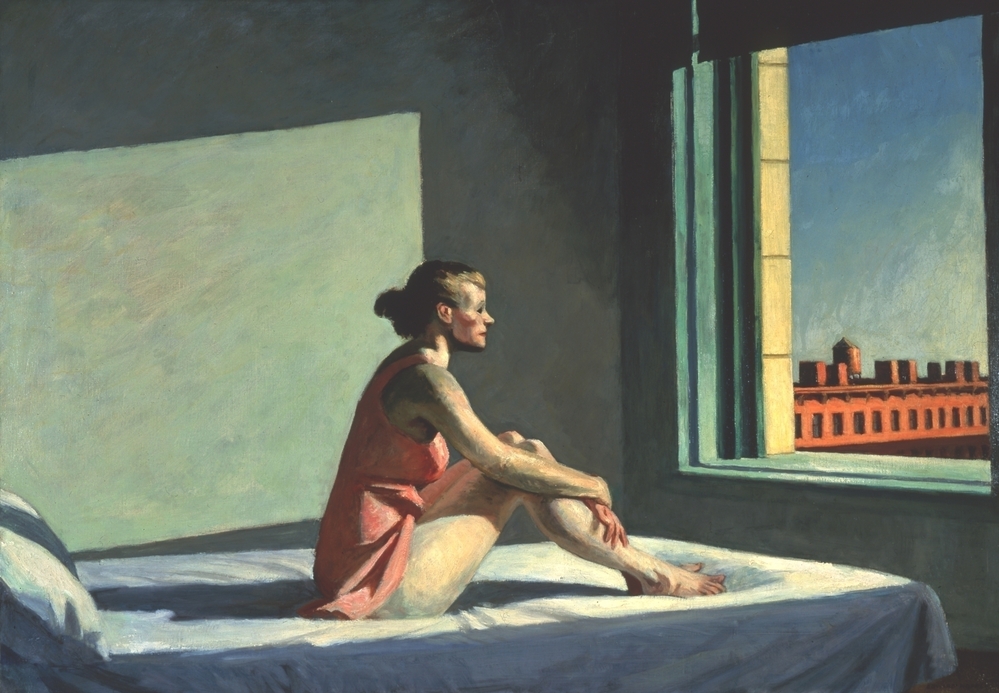
Earlier this summer, I looked for Edward Hopper's Morning Sun at its home in the Columbus Museum of Art in Ohio. In the painting, a woman sits on a bed with her knees up, gazing out a window. She's bare, but for a short pink slip. The iconic Hopper is a must-see, but on the day I visited, it was on loan to an exhibition in Madrid.

Edward and Josephine Hopper met as young students in art school in New York and married in 1924. Josephine was his only female model, and posed for his 1952 work, Morning Sun.

Columbus Museum of Art/Howald Fund Edward and Josephine Hopper met as young students in art school in New York and married in 1924. Josephine was his only female model, and posed for his 1952 work, Morning Sun. Edward and Josephine Hopper met as young students in art school in New York and married in 1924. Josephine was his only female model, and posed for his 1952 work, Morning Sun.

Columbus Museum of Art/Howald Fund

I finally caught up with Morning Sun in Paris, where it is on display as part of a Hopper show at the Grand Palais. When I first walked in, the gallery was empty, but not for long. The room quickly filled — as has the whole exhibition — since it opened in October.

Curator Didier Ottinger says the crowds for the Hopper show rival the crowds for Picasso or Monet exhibits — and that surprised him. He never expected his exhibition of the American realist's work to become such a phenomenon. Though Hopper is a favorite in the U.S., French museums don't own his work, so the French don't know the painter very well. Now that they've been introduced, they like him quite a bit — they like his colors, his people and his light.

Hopper shows men and women, bathed in light from open windows, or under fluorescent light — those figures drinking coffee from hell in a nighttime diner. They all seem isolated and lonely. The fact that the images are based on the lives of ordinary people is very American, Ottinger says, but the French still see themselves in these paintings. "Each of his works is a kind of screen where everybody ... is able to project his own feelings, his own emotions," Ottinger says.

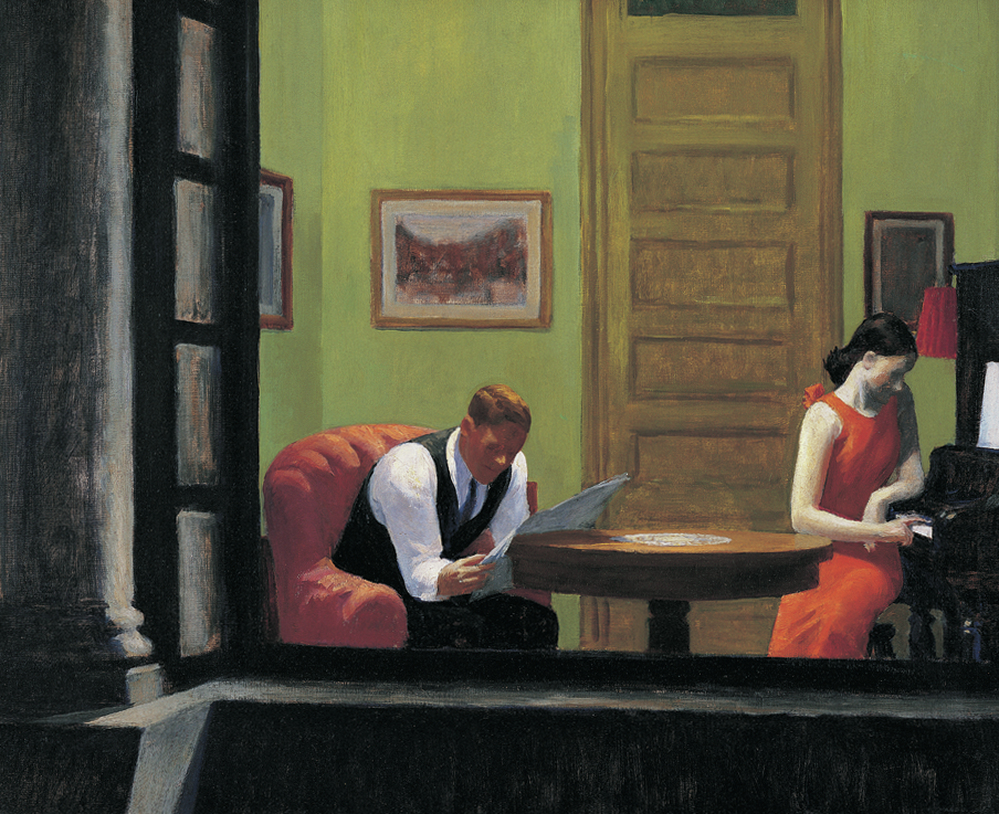
Hopper painted Room in New York (oil on canvas) in 1932. It was around the same time his wife, Josephine, started writing in her diary about her frustrations with her husband becoming a famous artist.

Sheldon Museum of Art, University of Nebraska—Lincoln, Anna R. and Frank M. Hall Charitable Trust. Hopper painted Room in New York (oil on canvas) in 1932. It was around the same time his wife, Josephine, started writing in her diary about her frustrations with her husband becoming a famous artist. Hopper painted Room in New York (oil on canvas) in 1932. It was around the same time his wife, Josephine, started writing in her diary about her frustrations with her husband becoming a famous artist.

Sheldon Museum of Art, University of Nebraska—Lincoln, Anna R. and Frank M. Hall Charitable Trust.

Hopper never painted narratives; it's up to us to impose our own stories on his images. But, says Ottinger, there are autobiographical elements in the paintings. In Hopper's 1932 painting Room in New York, a man and a woman sit together but alone. The man is engrossed in his newspaper; the woman seems lost in thought, one finger placed on the key of a piano. They're so removed from one another.

"And this is precisely the time when his wife, Josephine, was starting to write her own diary where she expressed her frustration because he was becoming a famous painter," Ottinger says.

Edward and Josephine Hopper met as young students in art school in New York and married in 1924. "And very, very fast he became one of the key figures in realism of this period, and she was left behind," Ottinger says.

At her insistence, she became his only model. That way, Jo felt that she played a part in the creation of his paintings, and Hopper encouraged this interpretation. Jo had wanted to be an actress, but that never worked out, Ottinger explains, so her husband "gave her this kind of chance to be his only actress, and every single painting is a kind of small play."

So that's Jo in the pink slip, sitting by the open window in Morning Sun. "More than solitude, more than melancholy, this painting is expressing a kind of awakeness," Ottinger says. The woman staring out that window is aware of what the day and her life are really about.

"She's awake ... ," Ottinger says, snapping his fingers. "There is something higher, there is something bigger, there is something more cosmic than this sad and ordinary life which is expressed by this gloomy room. ... I think this is precisely what is always interesting — something which can be depressing, but at the same time, there is always hope."

Edward Hopper, seen in a new light in Paris. (A friend says Hopper — himself a Francophile — would be thrilled to find his works on view so near the Louvre.) Ottinger's exposition of this major 20th-century American painter remains at the Grand Palais until the end of January.


View the original article here

Remembering A Rock Star: Photographer Ken Regan

Elvis Presley, early 1960s, with Nancy Sinatra. "I knew I would have to hustle in this competitive business if I wanted to make a name for myself .... But I had to make it to this one: Sgt. Elvis Presley, stationed for two years in Germany, was flying in to meet with the media at Fort Dix, N.J., on the eve of his discharge." Hide caption Elvis Presley, early 1960s, with Nancy Sinatra. "I knew I would have to hustle in this competitive business if I wanted to make a name for myself .... But I had to make it to this one: Sgt. Elvis Presley, stationed for two years in Germany, was flying in to meet with the media at Fort Dix, N.J., on the eve of his discharge." Hide caption The Beatles with Ed Sullivan, 1964. "The audience in the 703-seat theater shrieked nonstop. This was at the deafening dawn of Beatlemania. You couldn't hear a thing. Some fans just seemed to be in shock, staring ahead, tears running down their cheeks." "When The Beatles returned to America in August, 1965 ... I got one of my favorites. Walking the aisles, one audience member caught my eye: an older man sitting with his fingers plugged in his ears to mute the high-pitched squeals. As I moved in for this terrific shot, I got a closer look and realized I was photographing the legendary composer and conductor Leonard Bernstein." Hide caption "When The Beatles returned to America in August, 1965 ... I got one of my favorites. Walking the aisles, one audience member caught my eye: an older man sitting with his fingers plugged in his ears to mute the high-pitched squeals. As I moved in for this terrific shot, I got a closer look and realized I was photographing the legendary composer and conductor Leonard Bernstein." The Rolling Stones on Saturday Night Live, 1978. Bill Murray blow-drying Ron Wood's hair. Hide caption The Rolling Stones on Saturday Night Live, 1978. Bill Murray blow-drying Ron Wood's hair. Hide caption Sonny and Cher, 1966. "I truly lucked out with the kind of access that almost no longer exists. 'I Got You Babe' had been a number one hit in the summer of 1965, but the sassy, animated couple — Sonny was 34, Cher was 19 — couldn't have been more cooperative, friendly, and open." Hide caption Woodstock, 1969. "Woodstock was not just the mother of all rock festivals, it was a photographer's paradise." Hide caption Arlo Guthrie and Pete Seeger confer at a benefit played in Tarrytown, N.Y., for Hudson River Sloop Clearwater Inc., 1969. "He's the son of populist folk pioneer Woody Guthrie, but Arlo Guthrie, when he was only twenty-two, had found his own voice with his sardonic, counterculture anthem, 'Alice's Restaurant.' " Hide caption Mick Jagger's 29th birthday party. "At the party I photographed Mick and Keith with Bob Dylan at a time when Dylan sightings were extremely rare. Why was he there? Maybe the folk-rock icon was curious to meet up with rock 'n' roll's greatest icons-in-the-making." "Once ... I thought, God, that smells really good, like eggs or something. I went into the kitchen — this was still midday — and there was Keith, standing over a frying pan at the stove, without a shirt on, cooking up some eggs. I had to do a triple take: he never got up much before six or 7 p.m. Thank God I had my camera because this was a one-in-a-million shot." Hide caption "Once ... I thought, God, that smells really good, like eggs or something. I went into the kitchen — this was still midday — and there was Keith, standing over a frying pan at the stove, without a shirt on, cooking up some eggs. I had to do a triple take: he never got up much before six or 7 p.m. Thank God I had my camera because this was a one-in-a-million shot." Tour of the Americas, on the plane between San Antonio and Kansas City,June 1975, (left to right) Bianca Jagger, Ron Wood, Charlie Watts and Keith Richards. Hide caption Tour of the Americas, on the plane between San Antonio and Kansas City,
June 1975, (left to right) Bianca Jagger, Ron Wood, Charlie Watts and Keith Richards. In the fall of 1977, I did a home take and a People cover (with Mick and Keith) of a very mellow, domesticated Keith Richards with his girlfriend of ten years, Anita Pallenberg, and their eight-year-old son, Marlon." Hide caption In the fall of 1977, I did a home take and a People cover (with Mick and Keith) of a very mellow, domesticated Keith Richards with his girlfriend of ten years, Anita Pallenberg, and their eight-year-old son, Marlon." Westbury Music Fair, January 1970, Jim Morrison and The Doors Hide caption Westbury Music Fair, January 1970, Jim Morrison and The Doors Janis Joplin at the Fillmore East, March 1968 Bob Dylan checking a Halloween mask in the mirror, Plymouth, Mass., Rolling Thunder Revue tour, 1975. Hide caption Bob Dylan checking a Halloween mask in the mirror, Plymouth, Mass., Rolling Thunder Revue tour, 1975. "Merry players" on the beach, Bob playing trumpet. Thanksgiving, 1975, Sturbridge, Mass. Hide caption "Merry players" on the beach, Bob playing trumpet. Thanksgiving, 1975, Sturbridge, Mass. Joan Baez and Bob Dylan practicing backstage, Rolling Thunder Revue tour, 1975. "Rolling Thunder was unlike any tour before it or since — an antic, in-the-moment carnival of impromptu happenings starring an ever-shifting cast of offbeat characters. Bob had given me free rein to shoot it all — onstage, backstage, offstage, dressing rooms, parties, trailers, whatever was going on." Hide caption Joan Baez and Bob Dylan practicing backstage, Rolling Thunder Revue tour, 1975. "Rolling Thunder was unlike any tour before it or since — an antic, in-the-moment carnival of impromptu happenings starring an ever-shifting cast of offbeat characters. Bob had given me free rein to shoot it all — onstage, backstage, offstage, dressing rooms, parties, trailers, whatever was going on." Hide caption Rolling Thunder Revue tour, Montreal, 1975. ' "What's with the whiteface?" I asked Bob as he was being made up before a show. Nobody could figure that out. He said, "Well, I'm playing these halls and it's really dark. I want the people way in the back to be able to see my eyes." Okay. Whatever." Iggy Pop in New York for the Dec. 10, 1984, issue of People magazine. "By the time I shot Iggy for People in late 1984, he had calmed down quite a bit. He was 37, and a cool, terrific, and very amenable subject." Hide caption Iggy Pop in New York for the Dec. 10, 1984, issue of People magazine. "By the time I shot Iggy for People in late 1984, he had calmed down quite a bit. He was 37, and a cool, terrific, and very amenable subject." "In 1970, Time sent me down to Hendersonville, Tenn., near Nashville, for a story on Johnny Cash. I spent a couple of days with Johnny and his wife, June Carter Cash, photographing them at their home. The shoot was both a challenge and a thrill." Hide caption "In 1970, Time sent me down to Hendersonville, Tenn., near Nashville, for a story on Johnny Cash. I spent a couple of days with Johnny and his wife, June Carter Cash, photographing them at their home. The shoot was both a challenge and a thrill." Hide caption "In 1977, Peter Frampton was filling 90,000-seat stadiums as a good-looking songwriter and fluid, blues-rock guitarist who made upbeat lollipop rock. I shot him in several situations ... [including] at a sold-out concert in Philadelphia's JFK Stadium."

If you've been around longer than me, perhaps you were already familiar with Ken Regan's photography.

I'll admit: I didn't discover him until just the other day, under somber circumstances. A colleague forwarded this obituary in Rolling Stone, advising simply: "He's a big deal." The music photographer died of cancer one week ago.

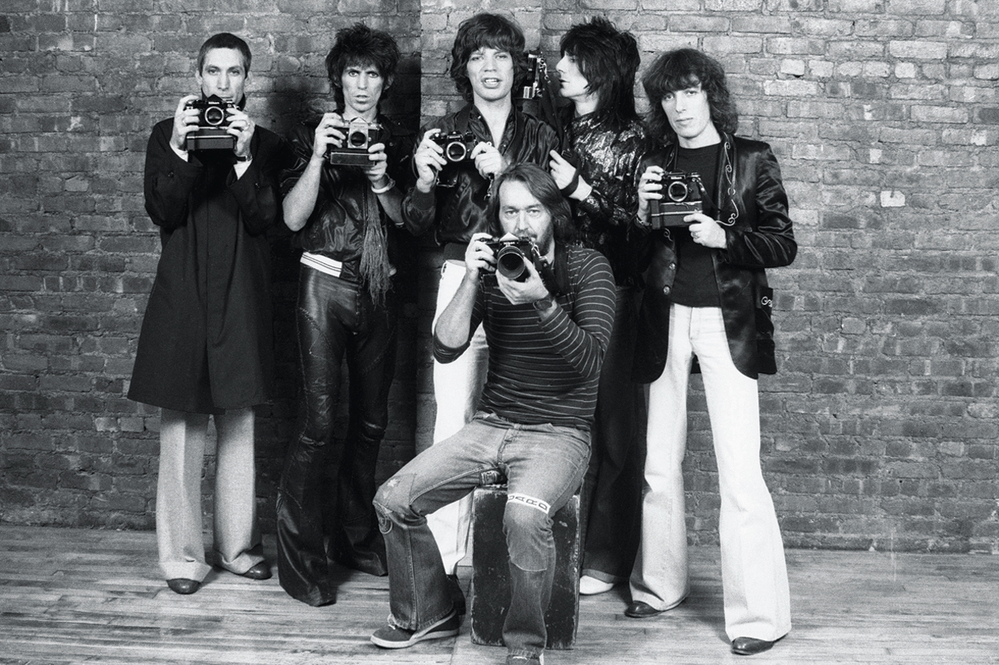
Photographer Ken Regan with the Rolling Stones, 1977

Courtesy of Ken Regan/Camera 5 Photographer Ken Regan with the Rolling Stones, 1977 Photographer Ken Regan with the Rolling Stones, 1977

Courtesy of Ken Regan/Camera 5

So I got a hold of his book, All Access, which was published one year ago this month; and after only a few minutes with his photos, I was enamored. I pored over his first-person anecdotes: Stories of his first important shoot — with Elvis Presley, who had just returned from Army service in Germany; of catching Leonard Bernstein plugging his ears at a Beatles concert; of accidentally drinking hallucinogenic punch backstage at a Rolling Stones concert; of his exclusive access to one of Bob Dylan's tours.

Granted, there's no shortage of Rolling Stones photos in the world. But how often does Mick Jagger write personal book introductions for photographers?

"As Ken would accompany us on our tours, it just so happened that I would end up accompanying him on his gigs as well," Jagger writes.

Regan's reputation was such that, with his kind of access, even the Rolling Stones would call on him for favors.

There's too much to say and too little space here, so I'll leave you with Regan's photos, captioned in his own words from the book.

I didn't know him personally, and regret that I missed the chance to ask him about his experiences. But the beautiful thing about being a photographer is that you're not just a witness to your time, but you also leave behind a visual legacy of your life.


View the original article here

Spain's Infamous 'Art Restorer' Hits EBay

Cecilia Gí­menez's handiwork: the Ecce Homo ("Behold the Man") fresco of Christ, left, and the "restored" version, dubbed Ecce Mono ("Behold the Monkey") at right. Now, the artist is trying her hand at selling her own art work.

AP Cecilia Gí­menez's handiwork: the Ecce Homo ("Behold the Man") fresco of Christ, left, and the "restored" version, dubbed Ecce Mono ("Behold the Monkey") at right. Now, the artist is trying her hand at selling her own art work.

AP

Cecilia Gímenez strikes again.

She's the 80-something Spanish woman who grabbed headlines last summer for what's purported to be the worst art restoration in history. The well-meaning retiree volunteered to touch up a 19th-century Ecce Homo — a painting of Jesus Christ — at her local church in the village of Borja, near Zaragoza in northeast Spain. But the result prompted horror from arts experts, and laughter from just about everyone else.

In Spain, the Ecce Homo — Latin for "Behold the Man" — has now been dubbed Ecce Mono — "Behold the Monkey."

Undeterred, Gímenez is at it again. This time, she's selling an original oil painting on eBay. The rustic cobblestone street scene entitled "The Bodegas of Borja" has fetched bids of more than $800 as of this writing — double the starting bid. The auction closes next week, on Tuesday, Dec. 18.

But Gímenez won't get the money. Instead, she's donated the painting to the Roman Catholic charity Caritas, to sell off as part of a Christmas fundraising drive by a church-affiliated radio station.

The elderly artist has already tried to cash in on her work, however: She's waging a legal battle against her church, for a share of the cash it's raised by charging admission to see her "restoration." Thousands of curious gawkers have made pilgrimage to the church — and its infamous fresco — since August.


View the original article here

Architect Oscar Niemeyer, Who Designed Brazil's Capital, Dies

Architect Oscar Niemeyer in 1960

Frank Scherschel/Time Life Pictures/Getty Images Architect Oscar Niemeyer in 1960 Architect Oscar Niemeyer in 1960

Frank Scherschel/Time Life Pictures/Getty Images

Architect Oscar Niemeyer, who designed Brazil's capital and is known for some of the world's most famous modernist buildings, has died. He was 104.

The cause was a respiratory infection, said a spokeswoman for the hospital in Rio de Janeiro where he died. He'd been hospitalized for several weeks with kidney problems, pneumonia and dehydration.

Here's more from The Associated Press:

"In works from Brasilia's crown-shaped cathedral to the undulating French Communist Party building in Paris, Niemeyer shunned the steel-box structures of many modernist architects, finding inspiration in nature's crescents and spirals. His hallmarks include much of the United Nations complex in New York and the Museum of Modern Art in Niteroi, which is perched like a flying saucer across Guanabara Bay from Rio de Janeiro."

In an interview with NPR in 2010, he recalled what it was like in 1956, when Brasilia was on the drawing board.

"Niemeyer says he went with President Juscelino Kubitschek to Brazil's vast, dry savanna, the so-called Cerrado region, where Brasilia is now located, and thought it was too far away, too empty.

"But Kubitschek, Niemeyer recalls, wanted to build no matter what.

"And so in four years, Brasilia was built from scratch, with Niemeyer designing its audacious buildings: the Brazilian foreign ministry with its slender arches rising from reflecting pools; the Cathedral of Brasilia, shaped like a giant orchid; the National Congress, with its two bowl-like structures, one up-turned, the other dome-like.

"These and others are all considered modernist masterpieces that capture the meaning of Brasilia: a new city, unburdened by history.

"'We wanted to do it differently' in Brasilia, Niemeyer says. 'Architecture is invention.'

"He didn't just want buildings that worked, but to create a different kind of architecture."

Brasilia's Cathedral was inaugurated in 1960.

Evaristo Sa/AFP/Getty Images Brasilia's Cathedral was inaugurated in 1960. Brasilia's Cathedral was inaugurated in 1960.

Evaristo Sa/AFP/Getty Images

Niemeyer, who began his career in the 1930s, was known for a distinctive style marked by sweeping curves, which he once famously said were inspired by Brazilian women.

"When you have a large space to conquer, the curve is the natural solution," he said. "I once wrote a poem about the curve. The curve I find in the mountains of my country, in the sinuousness of its rivers, in the waves of the ocean and on the body of the beloved woman."

The lifelong communist won the Pritzker Prize, his profession's top honor, in 1988.

Here's more about the early part of his career from the BBC:

"After graduating in the mid-1930s, he joined a Rio architectural firm run by a man who would become one of his great collaborators, Lucio Costa.

"Having won wide praise for a number of buildings in Brazil, he was chosen in the early 1950s to be part of an international team given the task of designing the UN buildings in New York.

"It was led by the great Swiss-born architect Le Corbusier, who was 20 years older than Niemeyer."

Niemeyer was working until the end. His most recent projects include a culture center for Aviles, Spain. A slideshow of some of his work can be seen here.


View the original article here

Big Gator Head Premieres At Miami Art Fair

One of the nation's largest art fairs is Art Basel Miami Beach. It's a city-wide event that has spawned dozens of satellite shows. The large alligator celebrates the artist Christo who used the power of art to cleanup Biscayne Bay.

Copyright © 2012 National Public Radio. For personal, noncommercial use only. See Terms of Use. For other uses, prior permission required.

DAVID GREENE, HOST:

Now to a hundred-foot-long alligator in Miami. Art Basel Miami Beach, one of the nation's largest art fairs, opens today. It's a citywide event that has spawned dozens of satellite shows and art happenings that have transformed the area with gigantic installations, including, as NPR's Greg Allen tells us, a very big alligator.

GREG ALLEN, BYLINE: Actually, it's just a mechanical alligator head mounted on a barge. But when the body is added, the entire artwork will measure nearly 300 feet, snout to tail. It's a huge project involving more than 100 people, from publicists to steel workers, and it began with one man's vision.

LLOYD GORADESKY: My name is Lloyd Goradesky. I'm the artist for "Gator in the Bay."

ALLEN: Goradesky is a photographer and artist who says he's never done anything approaching this size before.

GORADESKY: This is a large alligator to celebrate an artist, Christo, who used the power of rockets to help us clean up Biscayne Bay.

ALLEN: It was 30 years ago that Christo surrounded 11 islands in the Biscayne Bay with pink polypropylene fabric. Goradesky, now 54, was in junior high at the time, and it made an impression. He says it also helped jumpstart the cleanup of Biscayne Bay. Goradesky has modeled much of his project after Christo's work.

"Gator in the Bay," he says, is intended to raise awareness about the Everglades. It's also environmentally conscious. Almost all of the materials are used or recycled, beginning with the gator's skin, which is made from recycled, plastic fabric.

GORADESKY: The teeth are roofing material, and the steel is all used metal. If you step back and you check out the eyes, the frame of the eye is made from a spool. And so we really had a lot of fun assembling the materials and making the piece.

ALLEN: Inside the gator's mouth last week, workers were putting last-minute welds on the intricate steel frame. "Gator in the Bay" is not just an art project. It's also a serious piece of engineering and steel construction.

VERN NIX: I'm Vern Nix, the owner of V&M Erectors. We're a steel-erecting company, primarily on bridges. Anything that has to do with steel is what we do.

ALLEN: Nix's crew took time off from building bridges to make the frame for the nearly 100-foot-long gator head. The top of the gator's mouth is attached to the arm of a Caterpillar excavator, which is part of the barge. As the gator head sails around Biscayne Bay, its mouth - controlled by the excavator - will open and close. But this is just the first phase of the project.

Next May, on the actual anniversary of Christo's surrounded island work, comes phase two, when Goradesky, Nix and others with the project add the gator's 200-foot-long body and tail.

NIX: The tail will be floating on four-foot-by-eight-foot Styrofoam panels that's got all these images on them that really looks like the skin of a gator. It's got, like, 6,400 photographic images that Lloyd took and came up with the procedure, I guess, of knowing how to put these in a color scheme of sequences so when you look at it from a distance, it all looks like alligator skin.

ALLEN: But that comes next year. Over the weekend, after workers put finishing touches on the gator head, the crew stood by while the mouth was opened for the first time.

NIX: Ready? Power's on.

(SOUNDBITE OF MACHINERY)

ALLEN: Warren Fronte is the owner and operator of the barge that's now topped by the steel and fabric gator head. Fronte's another important partner in an art and media project that he compares to an orchestra.

WARREN FRONTE: You have a conductor, and you have all your musicians. So look at this, you have an artist who's doing what he's doing, and then you've got a good ol' boy network who's doing what we're all doing.

ALLEN: "Gator in the Bay" is expected to make a splash at Art Basel beginning tonight, when it has its official premiere with a party at a Miami marina. Greg Allen, NPR News, Miami.

Copyright © 2012 National Public Radio. All rights reserved. No quotes from the materials contained herein may be used in any media without attribution to National Public Radio. This transcript is provided for personal, noncommercial use only, pursuant to our Terms of Use. Any other use requires NPR's prior permission. Visit our permissions page for further information.

NPR transcripts are created on a rush deadline by a contractor for NPR, and accuracy and availability may vary. This text may not be in its final form and may be updated or revised in the future. Please be aware that the authoritative record of NPR's programming is the audio.


View the original article here